
On 2 March 2026, the European Commission hosted the third consultation webinar in shaping the future EU Strategy for Vocational Education and Training (VET) 2026–2030. Entitled “Excellence, Innovation and Entrepreneurship in VET”, the session brought together policymakers, VET providers, social partners, regional authorities, and experts across Europe to reflect on scaling vocational excellence and strengthening VET’s role in competitiveness and innovation.
Following previous sessions on the international dimension and on quality and labour market relevance, this third webinar focused on four key priorities: Centres of Vocational Excellence (CoVEs), VET–business partnerships, innovative pedagogies, and entrepreneurship education.
LCAMP and the Basque Vision for Vocational Excellence
The webinar opened with Ms Andrea Leruste, Deputy Head of Unit at DG Employment, Social Affairs and Inclusion, highlighting the importance of grounding the EU VET Strategy in practical experience from Member States and regions. She emphasized that excellence in VET must be inclusive, embedded in regional ecosystems, and aligned with Europe’s digital and green transitions.
From LCAMP’s perspective, this aligns perfectly with our mission: to place learners at the center of advanced manufacturing education while strengthening regional innovation ecosystems. LCAMP demonstrates how transnational collaboration and learner‑centred approaches make excellence tangible, practical, and sustainable.
Centres of Vocational Excellence: Engines of Systemic Change
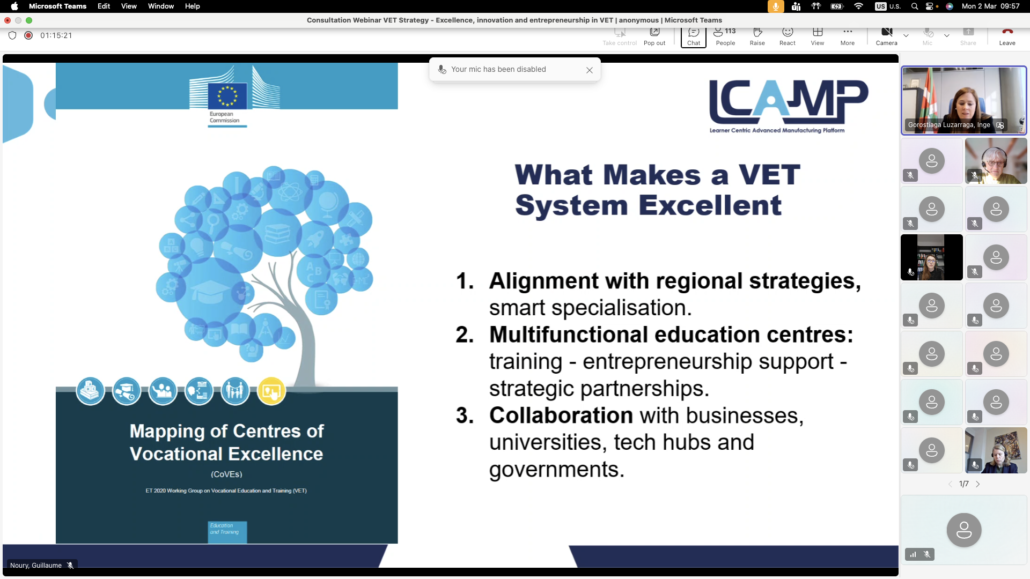
The first session explored CoVEs as drivers of innovation and regional development. Anna Barbieri (DG EMPL) shared insights from Erasmus+ CoVE projects, highlighting that vocational excellence thrives through strong skills ecosystems, cross-sector partnerships across the “knowledge triangle” (education, business, and research), and learner‑centred approaches supported by quality assurance.
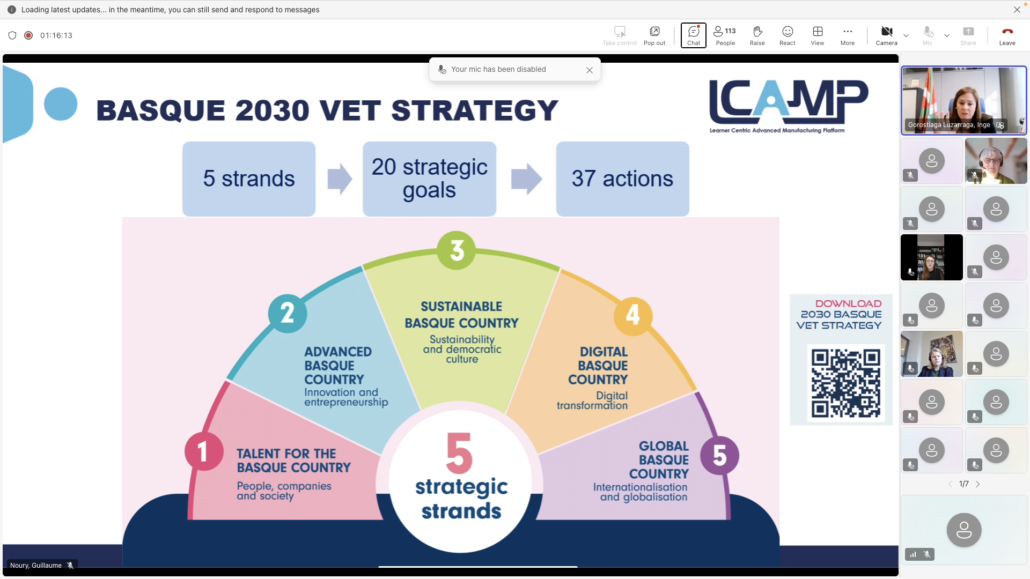
A particularly insightful contribution came from Inge Gorostiaga, Director for Digitalisation and Advanced Learning at the Basque Government. She shared the vision of the VI Basque VET Strategy 2030 (available here), positioning VET at the heart of regional competitiveness, industrial transformation, and social cohesion.
LCAMP itself was highlighted as a European flagship CoVE project focused on advanced manufacturing. Through LCAMP, we promote transnational collaboration, innovative learning environments, and joint curriculum development aligned with industrial needs. Participants were invited to join the LCAMP Alliance and engage in the upcoming LCAMP Conference in Vitoria‑Gasteiz (April 2026) — a space for peer learning, networking, and scaling vocational excellence across Europe. LCAMP exemplifies how regional leadership, European cooperation, and structured ecosystems can transform excellence from a project-level achievement to systemic impact.
Strengthening VET–Business Partnerships
The second session focused on structured, sustainable VET–business partnerships. Panelists and participants explored formal governance arrangements—especially in dual systems—as well as flexible, needs-driven cooperation models.
The discussions highlighted the importance of joint training facilities, shared equipment, and innovation hubs, particularly to support SMEs in accessing new technologies. LCAMP’s collaborative approach mirrors these principles, connecting learners, educators, and industry partners to co-create solutions and transfer knowledge across borders. A shared takeaway: employer engagement should evolve from consultation to genuine co-design embedded in curriculum development, delivery, and assessment.
Innovative Pedagogies and Entrepreneurial Mindsets
The third session addressed innovative teaching and learning approaches and entrepreneurship in VET. Participants shared experiences with learner-centred methodologies, including project-based learning, challenge-driven formats, and emerging technologies such as AI, VR, and digital twins.
LCAMP emphasizes these approaches, ensuring learners develop not only technical skills in advanced manufacturing, but also entrepreneurial competences such as initiative, creativity, resilience, and ethical thinking — essential across sectors. Micro-credentials, modular pathways, and flexible qualification designs were highlighted as tools to foster innovation and lifelong learning, reflecting LCAMP’s commitment to adaptability and learner-centric pathways.
Shaping the Future EU VET Strategy
The final plenary invited reflection on embedding excellence, innovation, and entrepreneurship at the system level. Key priorities included:
- Clear definitions and shared reference frameworks for vocational excellence;
- Long-term governance arrangements and quality assurance;
- Stronger European peer learning and mutual support;
- Continued investment in teacher and trainer professional development;
- Alignment between VET, regional innovation ecosystems, and industrial policy.
From LCAMP’s standpoint, these principles mirror our mission: to strengthen regional innovation ecosystems, scale excellence across borders, and ensure learners are equipped for the challenges of tomorrow.
The active participation of European, national, and regional stakeholders — especially the Basque Government — underscores a shared commitment to making VET systems engines of excellence, innovation, and entrepreneurial capacity throughout Europe. LCAMP is proud to be part of this transformative journey.